The Borrowed Skill: Passing Along a Useful Task Without a Formal Class
Borrowed skill teaching helps neighbours hand over a practical task clearly, with a visible sequence, a supervised try and a simple route for questions.
The commonest mistake in borrowed skill teaching is explaining a task while doing it at full speed. The learner sees moving hands and hears a running commentary, then leaves unsure which detail mattered; next time, someone else may have to take over. A short demonstration, a chance to try and a plain handover make the difference between watching and learning.
This approach suits everyday, non-specialist jobs: laying out chairs, sorting clean seed trays, setting out a noticeboard or preparing a shared table. The aim is not to turn a neighbour into an expert. It is to leave them able to repeat one bounded task, recognise when they need help and pass it on accurately.
Choose one task before explaining it
A task can look simple to the person who has done it for years and still contain several decisions. “Get the hall ready” might mean unlocking, checking the room, moving furniture, setting out cups and putting signs by the entrance. That is a bundle, not a single skill.
Choose a piece with a clear beginning and finish. For example, focus on laying out the folding chairs, not preparing the whole room. Say what the finished result should look like and identify anything outside the learner’s responsibility. If the work involves equipment, hazards or rules that need specialist knowledge, find an appropriate qualified person rather than treating an informal demonstration as training.
Keep the first explanation narrow. The learner can ask about the next part later; too many linked jobs make it hard to tell what they are meant to remember.
Show the sequence and explain the visible choices
People often assume the learner can infer the order from watching. That is how small but important details disappear: which way a sign faces, where spare parts go, or what should be checked before the job starts. Show the sequence slowly enough for the learner to see the choices, not just the motion.
Use ordinary objects as landmarks. When sorting seed trays, point out the clean stack, the tray with a cracked corner and the place where finished trays belong. Name each decision as you make it. Avoid a long speech about every possible exception; explain the usual route first, then mention the exception that changes what to do.
Say what you are checking, too. “I’m looking for a clear path past the chairs” is more useful than “That’s right” because it gives the learner a reason they can apply elsewhere. Keep the explanation tied to what is visible and relevant.
Give the learner a turn before the details fade
A demonstration can feel clear until the learner has to do the task. If the experienced person keeps hold of the tools or corrects every movement, the learner never gets to connect the sequence to their own hands. Once the demonstration is done, invite them to try the same bounded task while you stay nearby.
Say, “Would you like to set out the next row?” rather than handing over everything at once. Let the learner work at their own pace. If they pause, ask what they think comes next before supplying the answer. That gives you a chance to spot whether a step was missed or simply needs a moment to settle.
Correct only what matters for the result, and explain why. A different hand position or personal rhythm may be perfectly fine. The point is a dependable outcome, not a copy of the teacher’s mannerisms.
When should you pause or adjust the handover?
What if the task has too many parts?
Split it at a natural stopping point, such as sorting supplies before arranging them. Teach one portion, let the learner complete it, then introduce the next on another occasion if needed. Do not disguise several jobs as one small task just to save time.
What if you cannot explain a step clearly?
Pause and work out what you actually check before continuing. You might name a visual cue, such as a tray being clean and dry, or admit that the decision depends on information you do not have. If you cannot explain a necessary condition reliably, ask someone better placed to teach that part.
What if you have to step in?
Step in for a clear reason, not because the learner’s movements look unfamiliar. Name the concern, show the relevant part again and return control when appropriate. If the task proves unsafe or outside the learner’s remit, stop and seek suitable help instead.
What if the learner says they understand but looks uncertain?
Ask them to talk through the next action or show the first part again in their own words. Keep the question open and matter-of-fact, so it feels like a check on the explanation rather than a test of the person. Their answer will show which part needs another demonstration.
Leave a reminder and a clear route for questions
At the end, leave behind the smallest reminder that would genuinely help. A note on the supply cupboard might list where clean trays go and whom to ask if a stack is damaged. A short label beside the chairs might show the usual layout. A reminder should support memory, not attempt to document every conversation.
Before finishing, ask the learner to describe what they will do next time and what would make them stop or ask someone. Listen for the order, the expected result and the boundary of the task. If one part is missing, revisit it now rather than leaving a vague “you’ll be fine” to carry the handover.
Say who can answer a question later, especially if you will not be present. Keep that route specific: name the relevant neighbour or group contact, rather than sending the learner back to an open-ended “someone will know”. A useful handover includes a way to resolve the problem the learner cannot yet handle alone.
Keep the first independent attempt small
It is tempting to hand over the whole job as soon as the learner finishes one successful turn. Resist that urge if the task includes unfamiliar variations. Let them repeat the same bounded version independently, with an agreed point at which they can check in. That builds a dependable habit without pretending that one demonstration covers every situation.
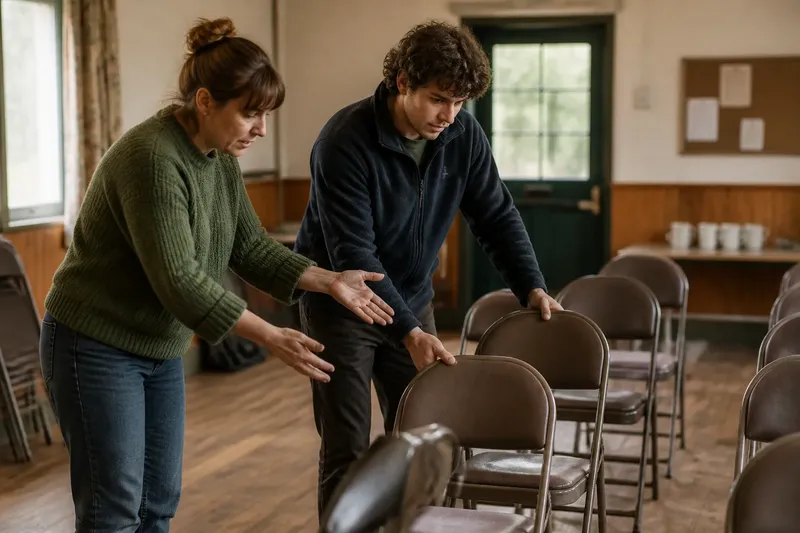
Imagine you are showing a neighbour how to set out folding chairs for a regular meeting. You begin with a clear space and a stack of chairs, demonstrate the usual arrangement, and explain how to keep the route through the room clear. The neighbour then sets out one section while you stay nearby; you point out a chair that needs setting aside rather than used. Before you leave, they describe where spare chairs belong and whom to ask about a damaged one. The resulting handover covers the defined layout task, while damage remains a reason to seek help.
What is not worth the effort is producing a polished guide for a task that changes with every occasion, or correcting harmless differences in style. A brief note and a clear contact are often enough. Put your energy into making the result observable and the boundary understandable.
For borrowed skill teaching, the strongest sign of a good handover is not that the learner repeats your exact movements. It is that they can explain the aim, complete the agreed task and ask for help at the right moment. When someone asks how to pass on a practical skill, keep the task small, show the choices and leave a named person to consult if the situation changes.