When a Community Group Has Too Many Ideas at Once
A community group with too many ideas can keep its energy without taking on every suggestion. Separate possibilities, decisions and next actions.
The common mistake when a community group has too many ideas is to treat each suggestion as a promise. Someone mentions a shared tool shelf, a spring clean and a children’s craft afternoon; by the end of the meeting, all three seem to belong to everyone. The cost is less time for agreed work and a lingering sense that volunteers have let one another down.
A better approach is to give ideas different statuses. Some are possibilities to keep, some are decisions the group has made, and some have a named person taking a specific next action. That distinction protects enthusiasm without turning a lively conversation into accidental workload.
Keep ideas separate from commitments
An idea can be worth hearing without being ready for approval. It may lack a volunteer, depend on access to a place, or simply need more thought. Saying so plainly is kinder than letting the room’s excitement imply that someone will organise it.
Use three clear labels in meeting notes or on a sheet of paper:
- Possibility: Record the suggestion and what information or interest would help the group judge it. If it remains worth considering, keep it for the next review; if not, remove it from the list.
- Decision: Write whether the group agreed to proceed, defer or decline. If a condition remains unresolved, record it and hold off on treating the proposal as approved.
- Next action: Name a willing person and a specific task. If nobody volunteers, leave the idea open or defer it rather than assigning work by silence.
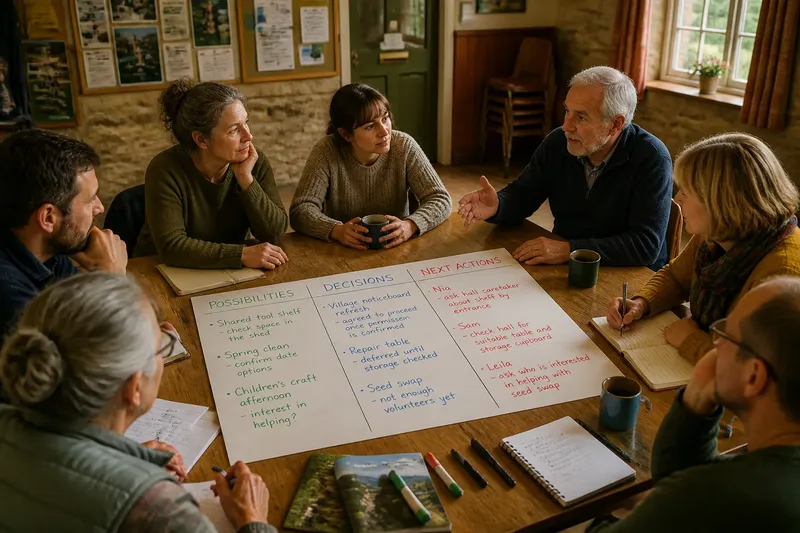
These labels do not need a formal system. A notebook, wall chart or shared document can do the job. Record what the group meant, not just the suggestion itself. “Consider a tool shelf” is a possibility; “ask the hall caretaker whether a shelf can go by the entrance” is a next action, not permission to install one.
Say you are at a village hall meeting and someone suggests a regular repair table. The group writes it under possibilities, then agrees that Nia will ask whether a suitable table and storage cupboard are available. The idea stays alive, Nia has one defined task, and nobody leaves believing a monthly event has already been promised.
Choose a light method or a fuller review
A lightweight parking list suits a group that meets occasionally, has few ongoing tasks and can keep track of current commitments without a long agenda. A fuller review suits a group juggling recurring duties, several active projects or volunteers with limited availability. Choose the method that makes unfinished work visible without making the meeting feel like paperwork.
A parking list suits an informal group
Keep a visible list of possibilities and add a short note about what would help the group judge each one. “Could the unused noticeboard carry local offers?” might need a conversation with whoever looks after the board. “Could we hold a seed swap?” might need someone to say they would be interested in helping.
At the next gathering, decide whether each idea is ready for a decision, still worth keeping or no longer relevant. This prevents every meeting from becoming a fresh pitch session. It also makes it easier to let an idea go without treating that choice as criticism of the person who raised it.
A regular review suits a busy group
Review proposals alongside current work. For each possible commitment, ask who would lead it, what existing task might need to wait, and what the first useful action would be. If nobody volunteers, the proposal remains an idea rather than becoming a task assigned by silence.
A review can also expose hidden dependencies. A proposed noticeboard refresh may depend on permission to use the wall, while a shared garden morning may depend on someone opening the gate. Name the dependency before deciding, so the group does not approve an activity while its hardest practical question remains unanswered.
Elaborate scoring sheets, colour-coded ranks and votes on every passing thought are not worth the effort if they take more time than the work they clarify. Add process only when it answers a recurring question the group cannot otherwise settle.
Decide whether an idea fits the group’s capacity
When an idea is ready for a decision, ask whether it fits the group’s purpose, whether anyone is willing to take responsibility, what current work it might displace, and whether the first action is clear enough to begin. A quick overview helps: if the purpose fits and a willing person can take a defined first action, consider proceeding; if a key detail is missing, seek that information before deciding; if there is no capacity or fit, defer or decline.
Capacity is not just the number of people in the room. It includes the time volunteers can offer, access to a suitable place, and any routine care the proposal would create. A one-off event can bring follow-up work: returning borrowed equipment, answering enquiries or putting a room back in order. Discuss those tasks before committing.
Imagine the group is considering a seed swap. The starting point is an unused noticeboard, a possible table in the village hall and no confirmed volunteer to organise the event. The group checks whether the hall can lend a table and asks who is willing to lead; a member offers to make those enquiries but not to run the swap. The group records that as the next action and defers the event decision. If the enquiries confirm a table and a volunteer later offers to lead, the group can decide whether to proceed; if no lead emerges, it can leave the idea parked without making a promise.
Choose an outcome everyone can repeat accurately: proceed, ask for information before deciding, defer until a stated occasion or decline. A deferral should say when or what would prompt another look; otherwise, the idea may follow the group from meeting to meeting as an unspoken promise.
Record decisions so neighbours know what is open
Minutes do not need to capture every remark. A useful record distinguishes proposals from decisions and lists actions with a person’s name and a clear verb. If the group deferred or declined an idea, record that briefly; otherwise, the same suggestion may return as though nobody answered it.
Before closing a discussion, read the wording back: “We have not agreed to run the event. We have agreed that Sam will ask about room availability, then we will decide.” This gives people a chance to correct a misunderstanding while everyone is still present.
Keep the record where members can find it, such as in the group’s shared folder or the notebook brought to meetings. The aim is not to archive every possibility. It is to let a neighbour who missed the meeting see what remains open, what has been settled and who has offered to do what.
Which idea-management method suits your group?
What should a small group do with a new suggestion?
Write it on a possibilities list and ask whether anyone wants to investigate it. If nobody volunteers, leave it open rather than assigning the work to someone who has not agreed.
How can a group stop ideas from disappearing?
Record each idea in one place with a brief note about what would make it ready for a decision. If it is still relevant at the agreed review, keep it; if not, remove it rather than carrying it forward indefinitely.
What if nobody volunteers to lead an idea?
Leave it as a possibility, defer it or decline it; general enthusiasm is not a willing lead. If someone later offers to take responsibility, reconsider it then.
When should a group choose a fuller review?
Use one when proposals compete with active projects or recurring duties. If the trade-offs are hard to see in an informal conversation, review them alongside current work before adding a commitment.
A community group with too many ideas does not need less imagination. It needs a clear boundary between welcoming a suggestion and accepting the work that follows. Keep that boundary visible in conversation and in the notes, and neighbours can find the current status of an idea without mistaking interest for a promise.